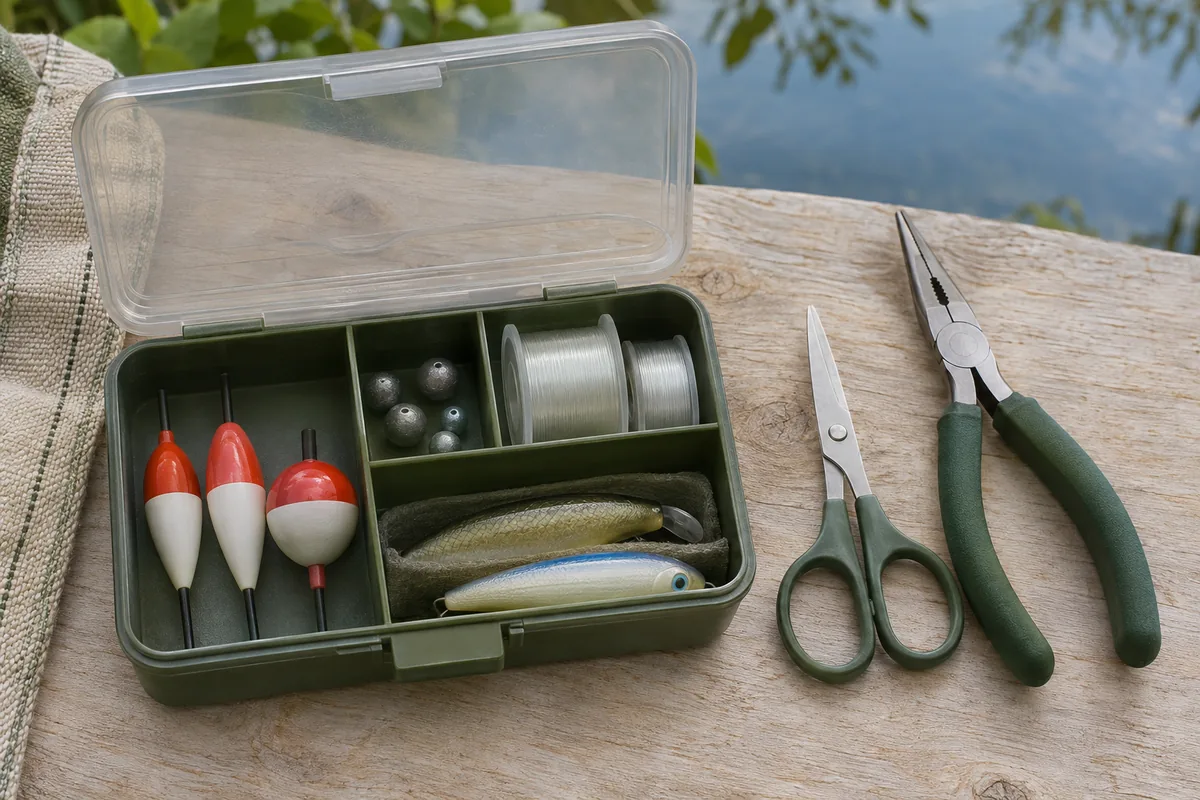
A good first tackle box is small enough to carry comfortably and organized enough that you can find a hook without emptying everything onto the bank. Build it around one method you understand. An assortment with dozens of unfamiliar pieces can make a first trip harder, even if it looks like better value.
The checklist below assumes a short freshwater bank-fishing trip with a simple bait-and-float setup, where that method is permitted. It is a packing framework, not a claim that one kit suits every water or species.
Decide what belongs in this trip’s box
Begin with the setup you intend to fish. If you cannot explain what a piece does, leave it on your research list rather than attaching it to your line. You can expand the kit after you identify a real limitation.
For a small pond outing, that might mean one hook style, one float style, and a modest selection of small weights. If bait is not allowed, or you plan to retrieve artificial lures instead, build a different small kit around that method.
Check the current rules for the exact water. Statewide guidance can be supplemented by water-specific restrictions on tackle, bait, access, seasons, or harvest.
The compact core
| Item | Its job | Packing decision |
|---|---|---|
| Appropriate hooks | Hold the selected bait and connect with the fish | One useful style, with a few replacements |
| Small floats | Suspend bait and show movement | Match their capacity to the rig, rather than choosing by color |
| Suitable weights | Help present the bait at the intended depth | Use only what the method requires; consider non-lead alternatives |
| Line cutter | Make a clean tag-end cut | A dedicated tool you can operate safely |
| Long-nose pliers | Handle hooks with more control | Keep accessible instead of buried under tackle |
| Small waste container | Hold clipped line and broken tackle | A closing container that will not spill |
For hook selection, use the hook-size guide. Do not buy a large hook assortment simply to cover every possible fish. A few appropriate replacements are easier to organize and inspect.
Add spares for likely failures
Think about what would end the trip early. Losing your only float is a reason to carry another float; it is not necessarily a reason to carry six different rigs. A small amount of the exact line you use can be useful if you know how to repair your setup, but replacing an entire spool beside the water may be impractical.
Put sharp items in secure compartments. Keep new and used hooks separate so a wet, corroding hook does not get mixed back into the clean supply. Store packets with labels intact until you are confident you can identify the contents.
If you bring artificial lures, start with a small selection that fits your rod’s casting range. Account for the total weight of the lure and any added components. More colors cannot fix an outfit that is badly mismatched.
Keep safety equipment outside the tackle checklist
A tackle box does not replace the rest of your trip preparation. Water, weather-appropriate clothing, sun protection, a suitable life jacket, and a communication plan belong in your broader bank-fishing checklist. Carry any required license or permit in the form your state accepts.
Check how you will handle a fish before you hook one. A landing net and removal tool may be more useful than another packet of lures. Follow local agency guidance on fish handling and know the rules before deciding to keep a catch.
Use a simple compartment system
Try four groups: sharp tackle, float-and-weight components, tools, and waste. Keep the pieces you need most near the top. Test the arrangement at home: can you open one compartment without loose hooks falling into another?
After fishing, remove wet items for drying, inspect what needs replacement, and note what you actually used. Wait for repeated evidence before adding equipment. A box that grows slowly around your own fishing is easier to understand than a prefilled collection you never learned to use.
For the rest of the outfit, read matching rod, reel, and line. Before putting the box away, follow the cleaning and storage routine.
Sources and further reading
- Missouri Department of Conservation: Fishing Gear — basic tackle and tool categories.
- New York DEC: Being a Responsible Angler — non-toxic tackle, care for fish, and responsible use of fishing waters.