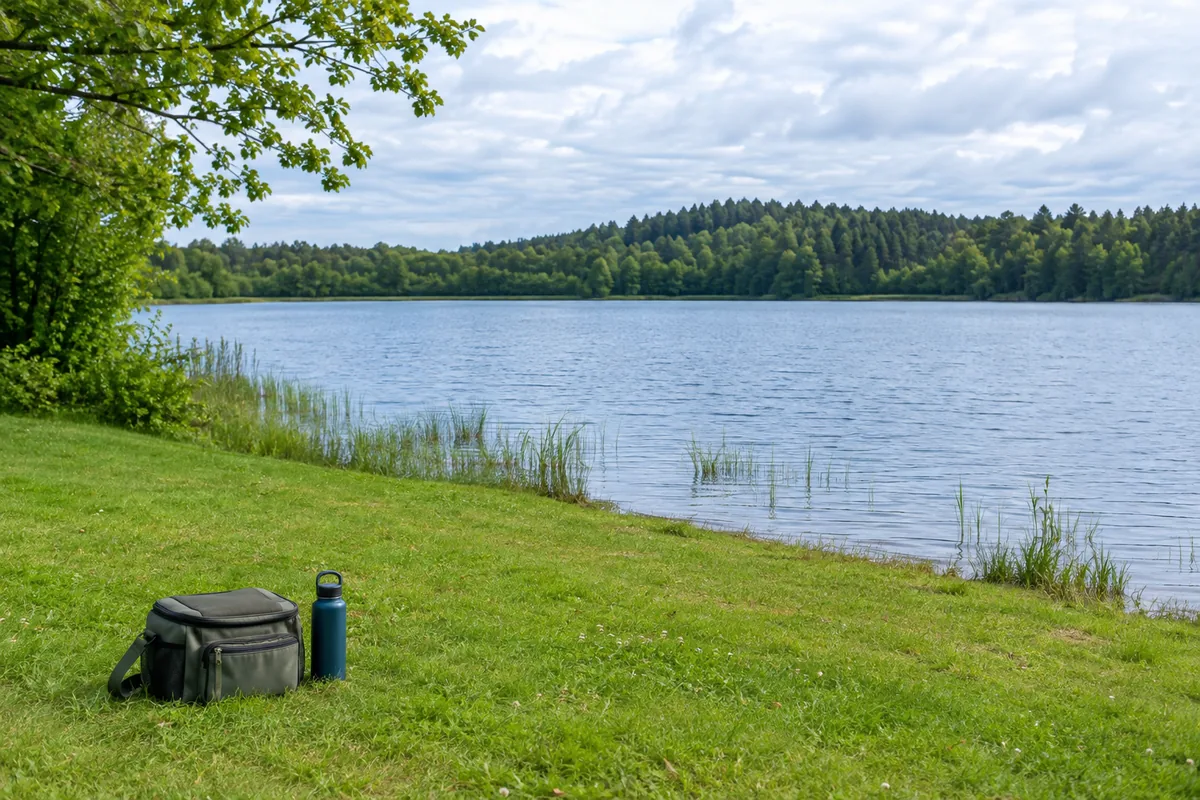
Bank fishing removes the need for a boat, but it does not remove the need to plan. Your most useful first destination is a legal, accessible place where you have enough room to cast and can leave easily if conditions change. Catching a fish is a good outcome; returning safely with a clearer understanding of your equipment is also progress.
This guide is for a short freshwater trip from a stable shore. It is not a guide to wading, fishing steep cliffs, navigating floodwater, or accessing remote banks.
Check the location before packing
Start with the state’s fish and wildlife agency and the land manager’s current information for that particular water. Confirm public access, parking, opening hours, any required license or permit, and water-specific rules. Do not assume a path to the lake establishes permission to fish there.
Look for an established fishing pier or an open, stable bank if you are unsure of your footing. Read accessibility information rather than inferring it from a map photograph. Check whether you can get back to the vehicle without crossing a gate that will close during the trip.
If you plan to keep fish, find the applicable species, season, size, and possession rules before leaving. Identify the species correctly and check local consumption advisories. There is no single set of fishing limits for the United States.
Pack for a short, simple session
| Bring | Why it belongs |
|---|---|
| One matched rod-and-reel outfit | Fewer components to manage while learning |
| Compact tackle kit and approved bait or lures | Enough for the planned method and a few replacements |
| Appropriate landing and hook-removal tools | A plan for the fish before it reaches the bank |
| Properly fitted life jacket | Protection around the water, not equipment left in the car |
| Drinking water and weather-appropriate clothing | A comfortable trip is easier to end before a problem develops |
| Charged phone and location plan | Tell someone where you will be and when you expect to return |
| Closing waste container or bag | Carry out line, packaging, and broken tackle |
Use the tackle-box checklist for the small components. Keep the load light enough that you can walk and maintain balance without juggling loose rods and open boxes.
Make a weather and exit plan
Read the forecast before leaving and keep watching conditions. Identify actual shelter in advance. An open-sided picnic shelter or a tree is not a safe lightning refuge. If thunder threatens, stop fishing and reach a substantial enclosed building or an enclosed hard-topped vehicle.
Know which route you will use to leave. Water conditions can change, and rain upstream may affect a river even if the sky above you looks clear. A first outing is not the time to explore an unfamiliar route down a steep or unstable bank.
Arrive before you cast
Pause and look around. Check for people, pets, overhead branches, power lines, unstable ground, and a clear place to land a fish. Keep hooks secured while walking. Never carry a rod where it could contact an overhead electrical line.
Choose a casting direction that leaves room for the entire motion, including behind you. Short, controlled casts are suitable practice. Reaching the middle of the lake is not a requirement for learning; keeping the hook away from other people is.
If the bank is crowded, wait or choose another safe position. Do not cast across someone else’s line or climb around them to reach a small opening.
Give the session one learning goal
Try to observe one thing: how your float behaves at a chosen depth, whether you can retrieve a lure consistently, or whether you can cast toward a large target. Make one considered adjustment at a time. Note what you changed instead of repeatedly switching equipment without a reason.
Before leaving, secure hooks, inspect the area for discarded line, and remove mud or vegetation from equipment. Follow the local agency’s cleaning requirements before using gear in another water. The gear-care guide explains how to separate everyday cleaning from invasive-species precautions.
If a trip feels unsafe, end it. Equipment and technique advice cannot turn poor access or dangerous conditions into a reasonable fishing plan.
Sources and further reading
- National Park Service: Reel It In — Fishing Safety — preparation, life jackets, casting hazards, and changing conditions.
- National Weather Service: Lightning Safety and Outdoor Sports Activities — recognizing when to stop and identifying appropriate shelter.
- Kentucky Department of Fish & Wildlife Resources: Learn to Fish — example agency access and education resources; use the equivalent agency for the state where you will fish.