For a newcomer planning to fish modest baits and lures from a freshwater bank, a spinning outfit is often a sensible first choice. A baitcaster can be useful, but learning one is a separate project. Choose around the fishing you will do rather than the idea that one reel is an upgrade everyone eventually needs.
This comparison explains equipment categories. It does not rank particular models or report product testing.
What changes between the two?
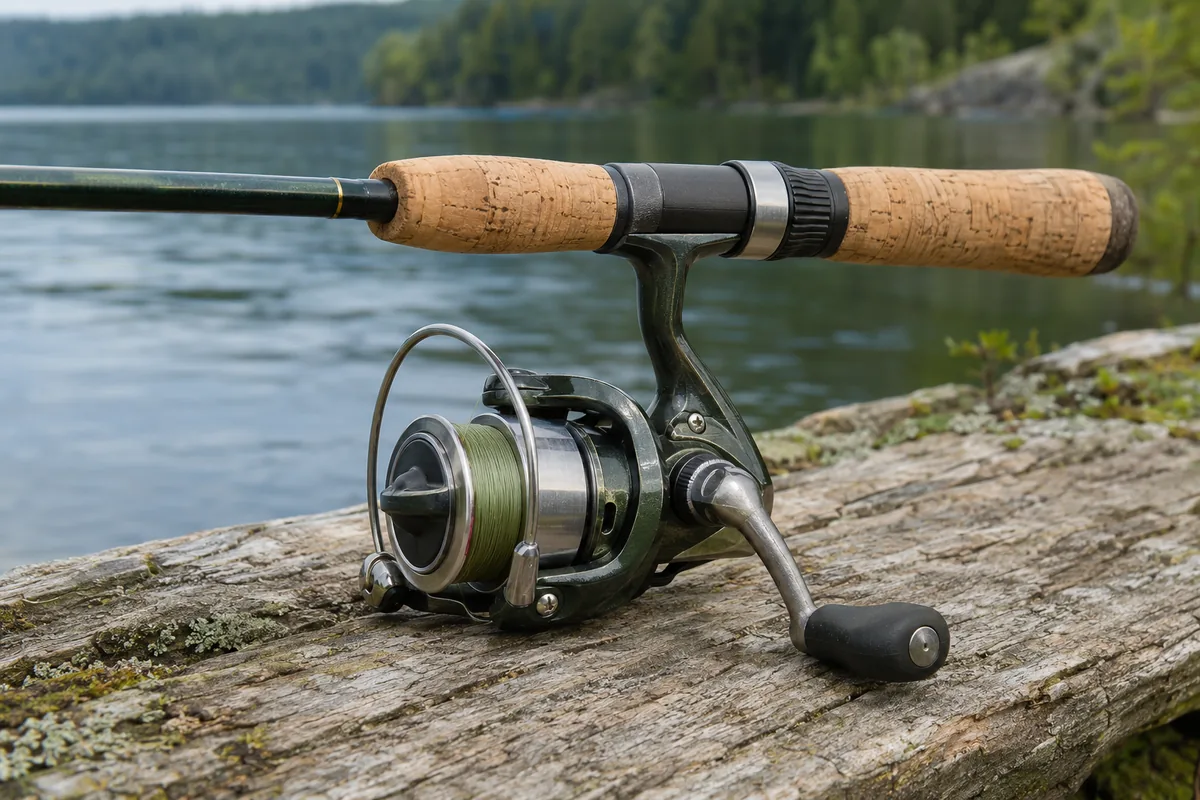
A spinning reel hangs below a spinning rod. For a cast, you hold the line with a finger and open the bail. The spool does not spin to release line during the cast. Afterward, the bail and line roller guide line back onto the spool as you turn the handle.
A baitcasting reel sits above a casting rod. Its spool rotates during a cast. The angler uses the reel’s controls and a thumb on the spool to manage that rotation. If the spool continues feeding line faster than the lure takes it away, line can pile into an overrun, commonly called a backlash.
That difference is more important for a first purchase than how professional or compact a reel looks.
Compare the jobs you need it to do
| Consideration | Spinning outfit | Baitcasting outfit |
|---|---|---|
| First few practice sessions | Learn finger release, bail operation, and line management | Learn spool control as well as the casting motion |
| Small freshwater presentations | Often a practical starting category | Check the reel and rod’s actual casting range carefully |
| Main tangle to understand | Loose loops and line twist | Spool overrun and backlash |
| Rod compatibility | Requires a suitable spinning rod | Requires a suitable casting rod |
| Buying another reel later | Optional, based on a new need | Optional, based on a new need |
Kentucky’s education page distinguishes spinning equipment for light lures and baitcasting equipment for heavier lures. That is a useful beginner distinction, not a rule covering every specialized reel. Some advanced equipment is built for exceptions; you do not need to solve those exceptions on your first trip.
Choose spinning if your priority is getting started
Imagine a trip to a small public lake with a float rig and an occasional small spinner. You want to learn casting direction, bait depth, and how to detect a bite. A correctly matched spinning outfit lets you focus on those tasks without simultaneously tuning a rotating spool.
Still, spinning gear is not tangle-proof. Check for loose loops before casting. Close the bail carefully, confirm the line is seated properly, and take up slack without winding a loose bundle onto the spool. If you see a loop, stop and correct it instead of hoping a hard cast will clear it.
For your first practice session, use a hookless casting plug within the rod’s rating in a clear, permitted area. Short casts toward a large target are more useful than trying for maximum distance.
Choose baitcasting for a specific reason
A baitcaster may make sense if you already know the heavier presentations you want to use, have suitable casting space, and are willing to practice. It also helps to have an experienced person show you the exact reel’s controls.
Do not copy a brake setting from an unrelated model. Centrifugal, magnetic, and electronically assisted systems operate differently, and the maker’s setup instructions take priority. Begin conservatively, practice short casts, and reset as the instructions require when the casting load changes.
Never clear a snag by loading the rod and pulling hard toward yourself. A freed lure can fly back. Changing reel type does not remove that hazard.
Where does spincast fit?
A closed-face spincast reel uses a push button and is another legitimate beginner option. It is a separate category from open-face spinning. If someone has loaned you a working spincast outfit, you can learn useful fishing skills with it rather than replacing it immediately.
Make the final decision
Ask whether the reel fits your hand, whether the retrieve side suits you, and whether you can understand its controls. Reel size numbers vary between makers, so check line capacity and compatibility instead of relying on the number alone.
Read how to choose your first rod and how to match the complete outfit. The best category for your first season is one that fits your actual fishing and helps you practice consistently.
Sources and further reading
- Kentucky Department of Fish & Wildlife Resources: Learn to Fish — beginner equipment categories and education resources; Kentucky rules are state-specific.
- New York DEC: Intermediate Fishing, Tackle and Techniques — spinning gear operation and line-loop troubleshooting.